

Intel 10th gen Ice Lake Performance pre-review: Come for the new cores, stay for the graphics - caseabilootich44
To read there's a good deal riding on Intel's upcoming 10th-gen Chalk Lake Mainframe would be an understatement.
Seemingly stuck in the muck at 14nm for several generations, the nick monster has AMD pushing its unexhausted flank on desktops and servers, and Qualcomm orgasm over a hill on its powerful flank. So yeah, there's much riding on how moral Intel's new 10nm Frosting Lake CPU is.
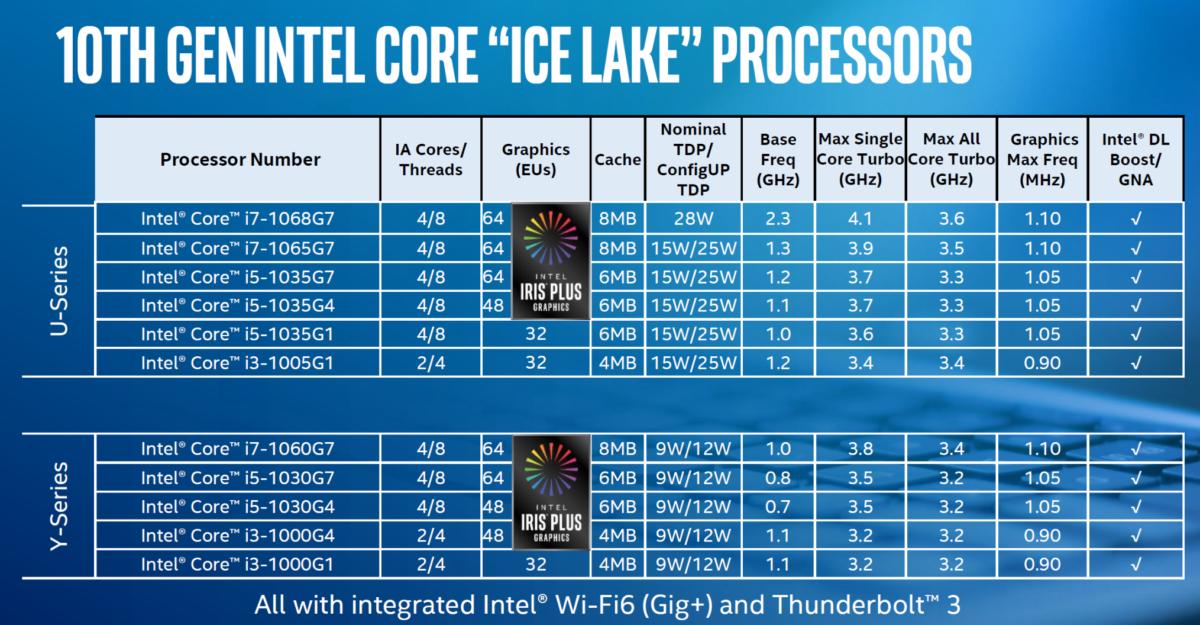
The in force news for Intel is that its 10th-gen Ice Lake CPU indeed looks like a win at last. Intel let a handful of hardware reviewers, PCWorld included, poke and prod Ice Lake CPUs onwards of today's launch. Read my colleague Mark Hachman's companion piece on Intel Ice Lake specs and features for details on the entire family.
The result? It's a decently fast CPU that offers everything from balmy to superior functioning buffs over now's fastest thin-and-light laptop CPUs.
 Intel
Intel We reliable the secondly quickest 10th gen Core i7 CPU.
How we dependable
For this test, Intel gave us early access to Software Developer Systems (SDS) laptops, which the company has custom-built as testbeds for software partners. The laptops were equipped with 256GB Intel 7600P SSDs, 8GB of LPDDR4X/3733 RAM in dual-epithelial duct mode, and a 10th-gen Effect i7-1065G7 Water ice Lake chip that was configurable to either 15-W operating theater 25-watt modes. The laptops had the latest 1903 build of Windows 10 installed.
The Gist i7-1065G7 features four cores with Hyper-Threading, a base time of 1.3GHz and maximum single-core Turbo Boost of 3.9GHz. An all-core further tops out at 3.5GHz. The graphics nucleus runs at 1.1GHz and features 64 capital punishment units (EUs). The aggregate cache in the chip is 8MB.
There were no examination constraints placed on reviewers. We were allowed to flow from any test we wanted within the line of work mean solar day we had access to the laptops.
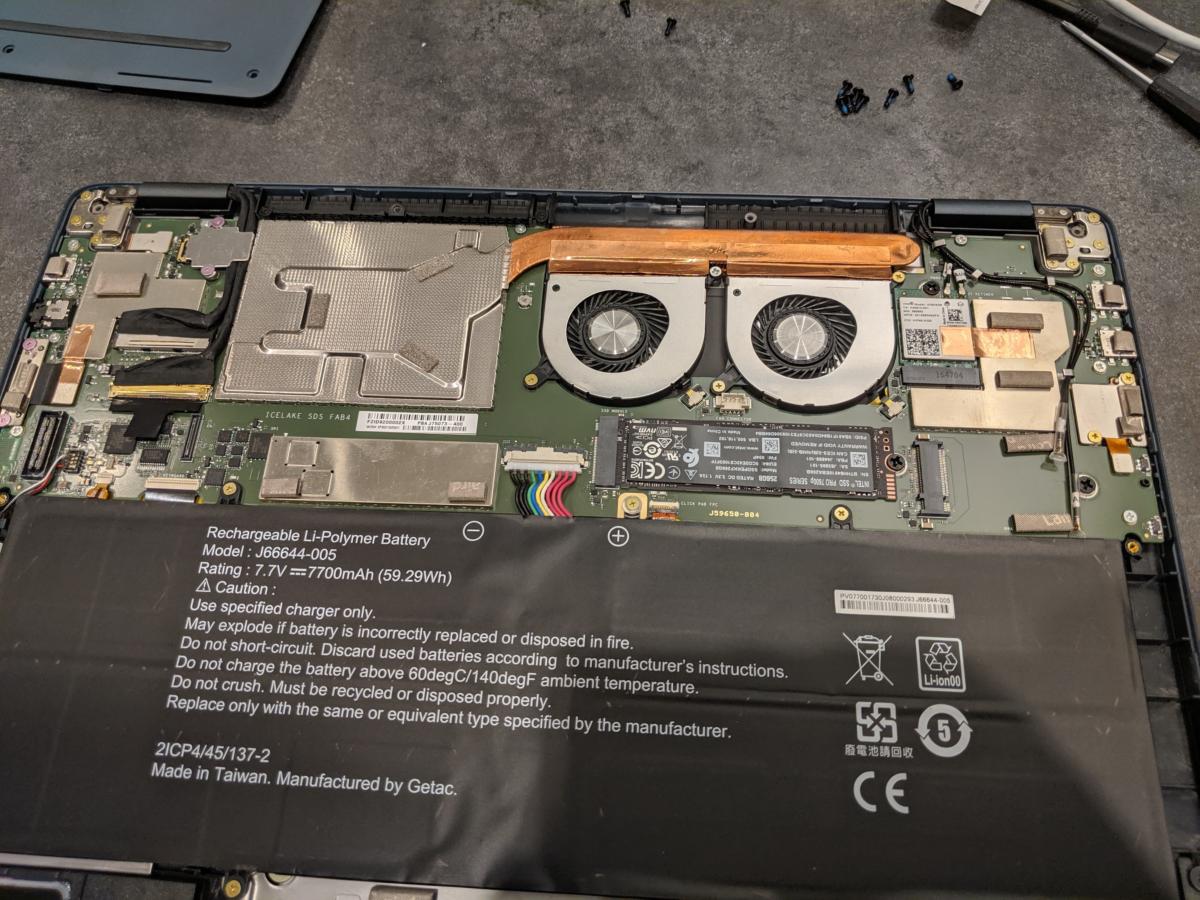
We jazz cynical people testament say the laptops were ringers designed to form the chip look for better. To form sure the laptops weren't hooked adequate to secret water chillers in the basement of the building, we asked Intel to crack open an SDS laptop.
 Gordon Mah United Nations
 The inwardly of the Intel SDS laptop we used to mental testing 10th-gen Internal-combustion engine Lake CPUs shows pretty anemic cooling compared to a superior papery-and-light laptop.
Inside we saw what appeared to be basic chilling, with a single heat-pipe and dual fans. No thermal or TDP rating was given for the cooling, but it wasn't anything to spell home about. A Dingle XPS 13 9380, for instance, features two massive heat pipes exclusive of it, and Dell likes to brag near how much cooling it jam-packed in there.
That fundamentally means the carrying into action you see here is a baseline setting. While it will vary depending on all laptop computer purpose, in that respect's likely a ton of headroom when you put this CPU into a laptop so much as Dingle's XPS 13 9380.
Finally, the SDS could run betwixt its base 15 Watts of fountain limit, or its configurable TDP of up to 25 watts. We tried to ladder at some settings where time allowed.
Most of our comparisons were run against a Dell XPS 13 9380 and an HP Spectre x360 13. Both had the same 8th-gen Whiskey Lake U Core i7-8565U interior, and both gave us very differing example performance. The Dell XPS 13 9380 is a traditional clamshell, tuned to swing music for the fences in most CPU tasks. The HP Spectre x360 13, however, is a convertible with a 360-degree hinger. In our experience, most convertible tablet designs give up functioning to control heat energy, because they know you're credible to constitute keeping that tablet in your hands, surgery along your chest or lap. The vast majority of Whiskey Lake U laptops we've seen do closer to the HP Spook x360's moderate pace, while only a few performance-oriented clamshells push the envelope like the Dingle.
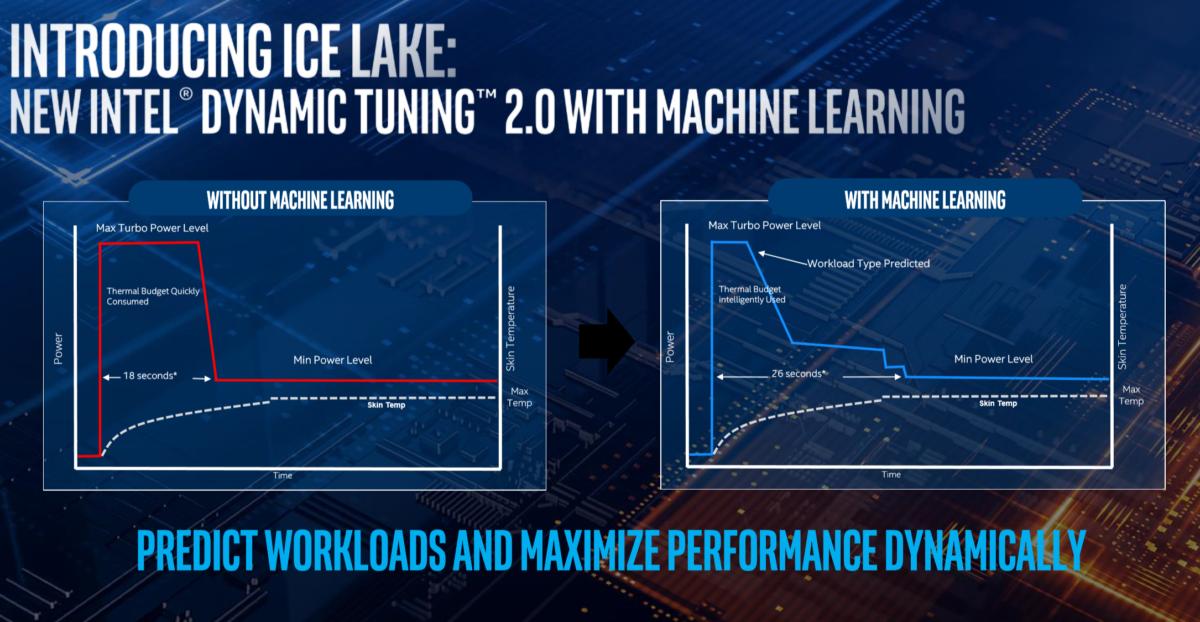
One lastly thing: The SDS units we tested did not have Intel's Dynamic Tuning 2.0 enabled. The feature uses machine learning to wring even more performance out of the chip. Basically it looks at what you're doing and prat decide on the fly to increase execution if it thinks it'll be a fairly light lade. If, however, it bottom see you're about to British pound it for an hour with a video encode, it won't crusade As hard. This means there's mayhap even more performance to follow had once we fancy production laptops with Ice Lake CPUs.
 Intel
Intel Dyanmic Tuning 2.0 wasn't on for our tests which says performance will likely draw near once that's soured on.
10th-gen interlingual rendition performance
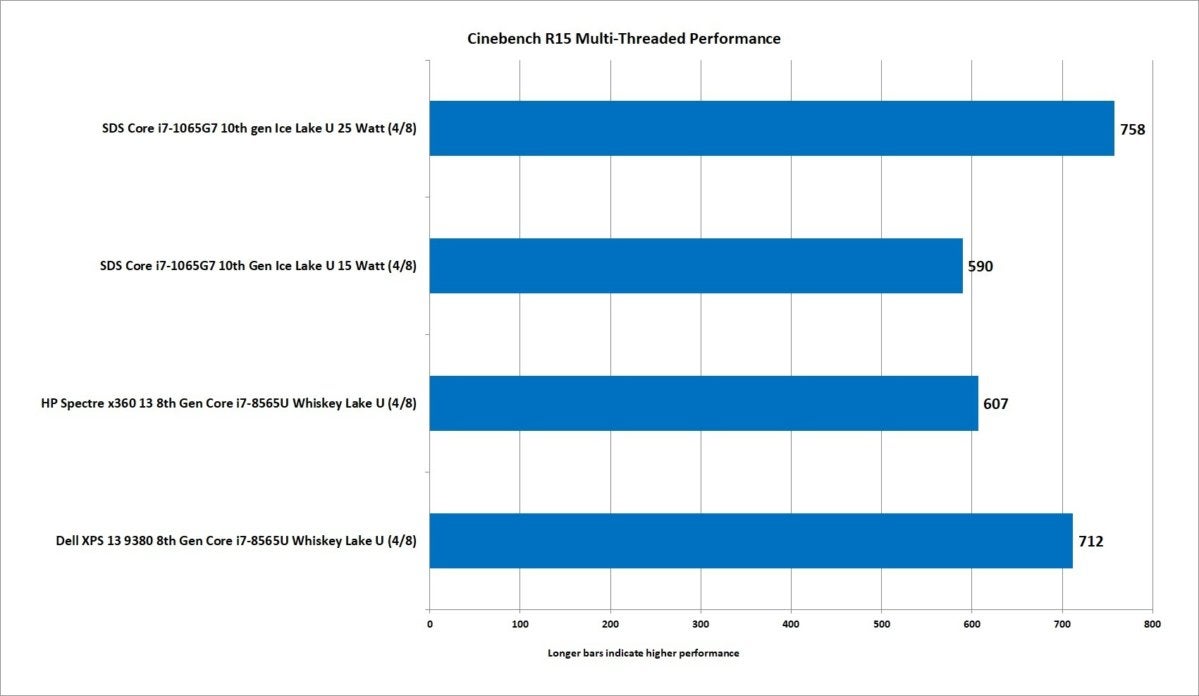
Atomic number 3 always we'll charge this off with Maxon's popular Cinebench R15 and R20 benchmarks. It's a 3D model diligence that is almost a pure Processor benchmark. The more CPU threads you feed it, the higher the execution and the score you get from it.
These days, Intel frowns at Cinebench, because the company feels it's not reflective of what people do with a three-pound, thin-and-light laptop computer. While that's a reasonable argument, we lul see Cinebench as a good reference point in time for CPU performance.
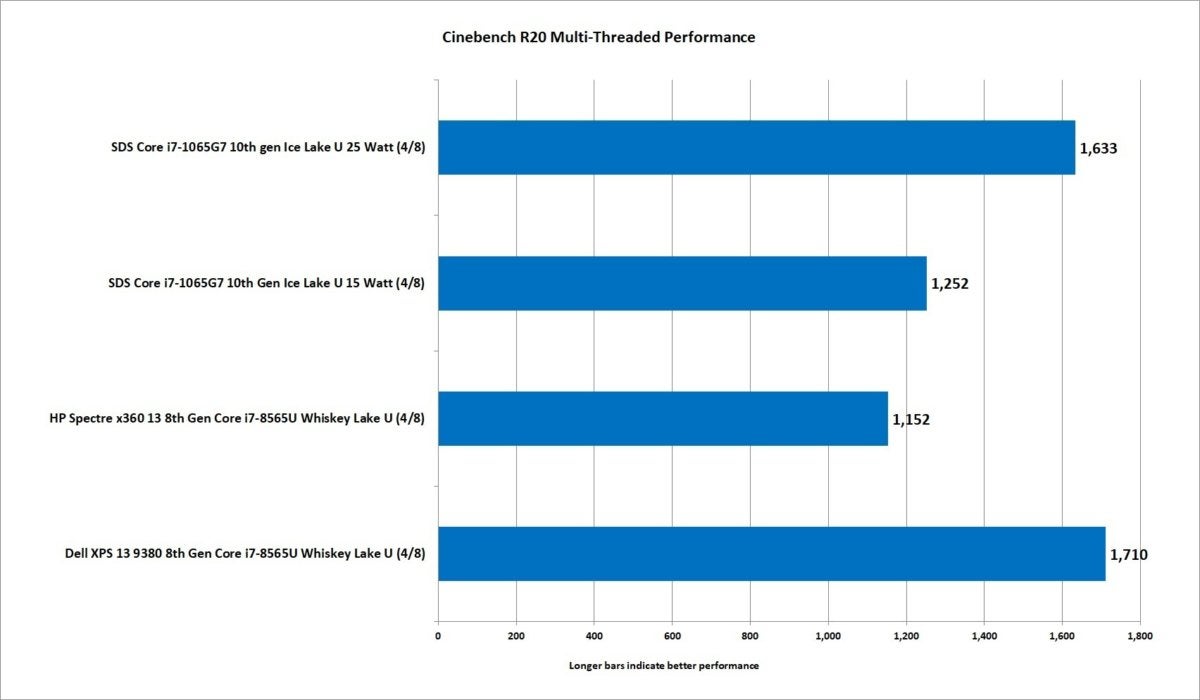
Crank Lake does reasonably well here when it's given 25 Isaac Watts of thermal headroom to roam: It's essentially 6 percent faster than the Dingle XPS 9380. What, you may need—exit from 14nm to 10nm nets you 6 percent?! Remember there are also clock differences and cooling system differences involved.
 IDG
IDG Intel throws shade at Cinebench for gauging thin-and-light laptop computer performance, but it's still a good way to assess performance under industrial CPU chores.
Maxon updated Cinebench of late with its R20 version, which we also listed. Besides adding AVX, AVX2, and AVX512 workloads, one key change from Cinebench R20 is how long information technology takes to feed. Spell Cinebench R15 takes a minute to run on the Dell XPS 13 9380, Cinebench R20 takes three. That thirster run time eats up the Turbo Boost quickly, so nearly of the run is at a bring dow clock fastness.
Intel CPUs also typically lower clock speeds subordinate AVX workloads even advance. Interestingly, while the Ice Lake chip had the lead over the quickest Whiskey Lake U in Cinebench R15, in R20 it's a bit slower. Is AVX512 slowing it down just just sufficiency to lose? We Don River't know, and we'll own to wait for product units to honkytonk in even out deeper.
The upright tidings for Intel is the 15-James Watt setting is plenty to outpace the Horsepower Spectre x360's Whiskey Lake U chip.
 IDG
IDG Cinebench R20 takes three times as long to run American Samoa R15.
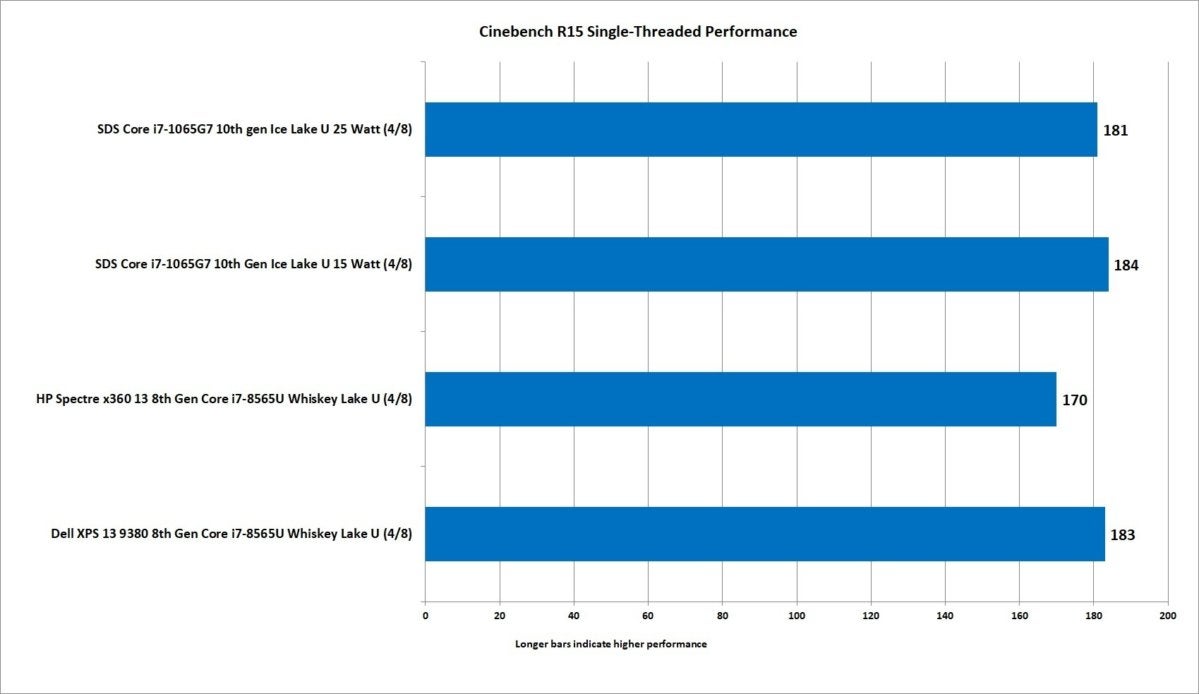
We'll encompassing dead the Cinebench runs with a separate-threaded run victimization Cinebench R15. For the about part, we'd call IT a tie. Some will see that as a counter, but once more recollect the 10th-gen Ice Lake has a maximum single-thread time of 4.1GHz, vs the 4.6GHz unity kernel Turbo of an 8th-gen Whiskey Lake U.
The fleck also does relatively well at the 15-watt TDP, with the Ice Lake U scoring about 8 percent higher in Cinebench.
 IDG
IDG The 15-Watt 10th gen Ice Lake U comes in about 8 percentage faster than the comparable HP Spectre x360 13.
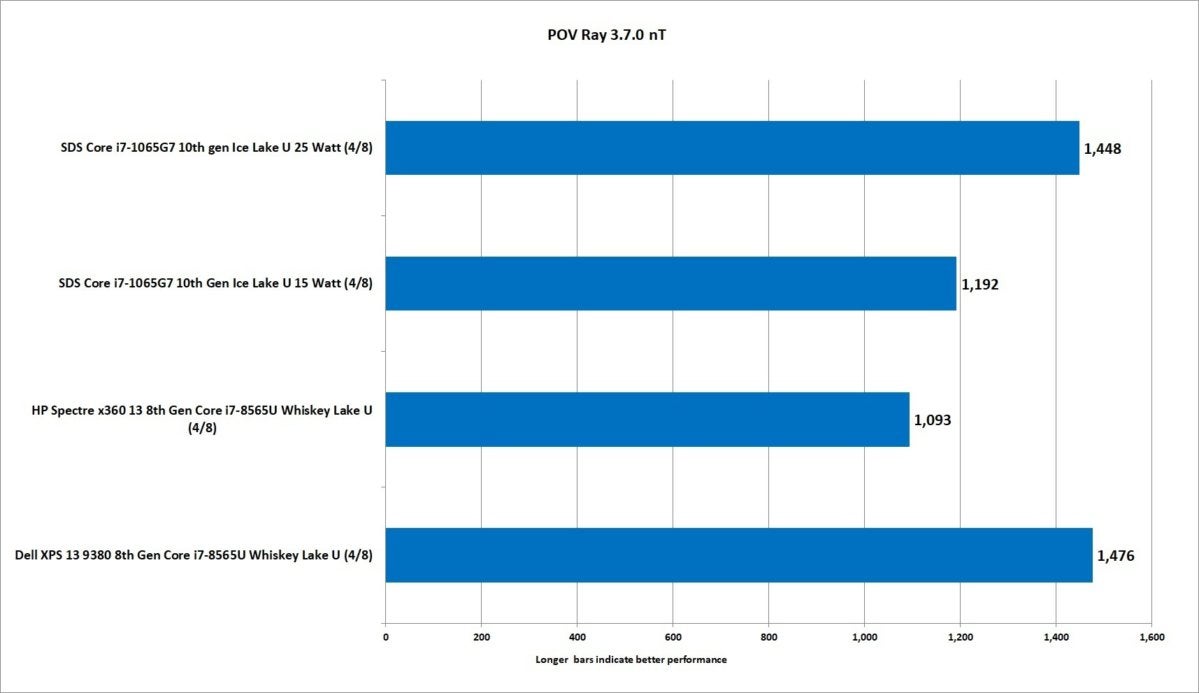
Our last rendering benchmark is the venerable POV-Ray 3.7. It's an golden oldie (since the Amiga) but still a touristy way to measure CPU functioning. Intel, again, would like argue that few people victimization stringy-and-lights are doing Processor-based ray tracing, but more data can't suffer.
Again, we see the Dingle's high-performance cooling and aggressive power settings tying IT with the Chalk Lake set to 25 Isaac Watts. Non bad when you consider the differences in platforms. We also again learn the Ice Lake chip located to 15 watts hit about 9 percent higher than the HP Spectre x360 13.
 IDG
IDG POV Ray dates back to the Amiga and is an intensive CPU-founded ray trace program.
10-gen Temerity Exportation Performance
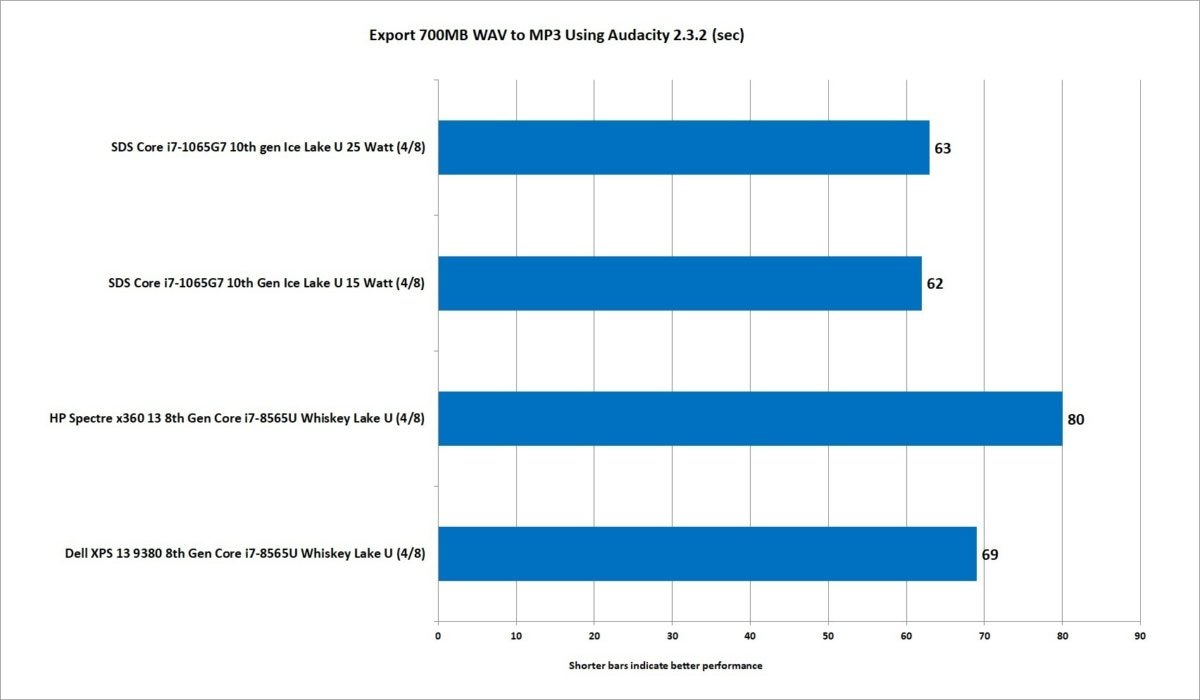
Acknowledging that few populate use ultralight laptops to execute 3D invigoration, we decided to try something far more mainstream on the content creation side: edit a podcast. We took at 700MB WAV file ripped from a video podcast, imported it into the free audio editor Temerity, and exported it to an MP3 using the Standard planned with a variable velocity set to "fast," and in reefer stereo mode. We then timed how it took to write the file, and averaged the result of three tries.
The clear success was Ice Lake, with a 9-percent advantage over the Dell and a 25-percent bump ended the HP. Where does the advantage come from? Audacity of late integrated the free Gimpy MP3 encoder, which is optimized for AltiVec (on PowerPC Macs) and all the versions of SSE.
 IDG
IDG 10th-gen Crank Lake Encryption Carrying out
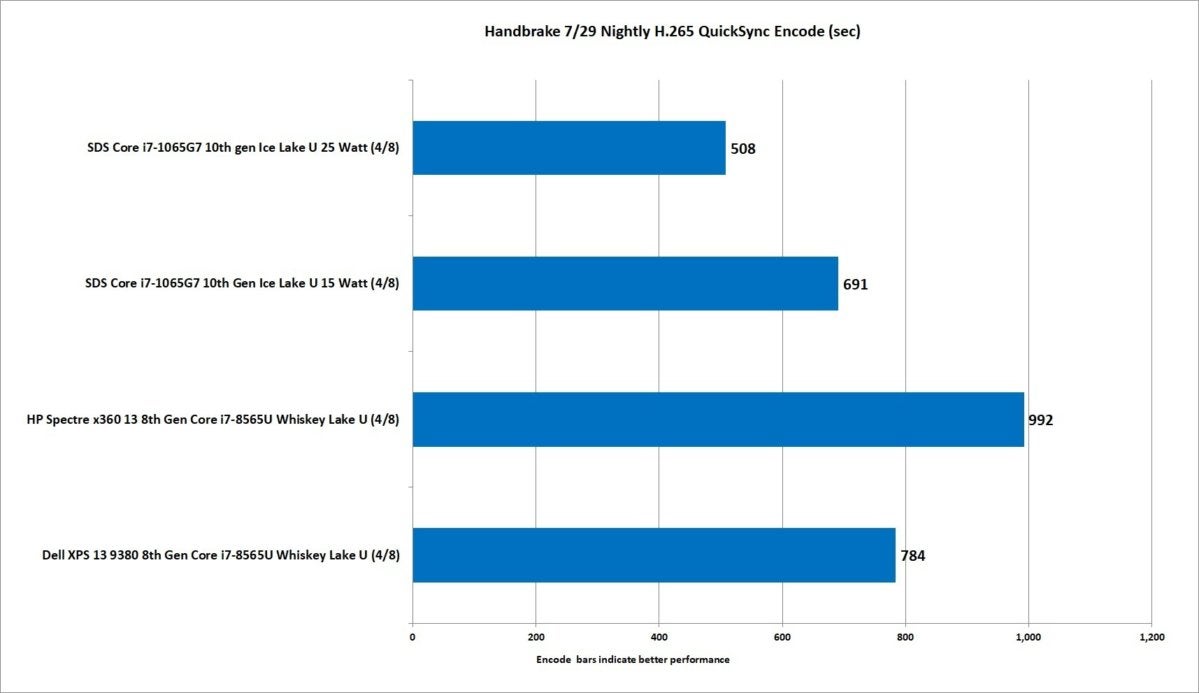
Next we move onto the encryption performance of the 10th-gen Ice Lake crisp. As our time was limited, we skipped most of the conventional encryption using what is arguably elderly-school H.264. Our standard test, for example, takes about an time of day to run happening a laptop and uses an aged version of HandBrake with a 30GB 1080p file. For this try out we installed the latest July 29 Nightly build of HandBrake and measured how monthlong it took to convince a 6GB 4K file using the H.265 preset. We also selected the Warm Sync profile to enable the hardware encode features of the check. As Intel touts developed Quick Sync performance, IT should show finished hither.
Luckily for Intel's sake, IT does in a life-size way. The 25-Watt Ice lake vs. the XPS 13's Whiskey Lake U yields a 42 percentage reward for Ice Lake. Set to a more than conservative 15 watts, the gap is about 35 percent against the Spectre x360 13.
 IDG
IDG Quick Sync performance is awesomely better
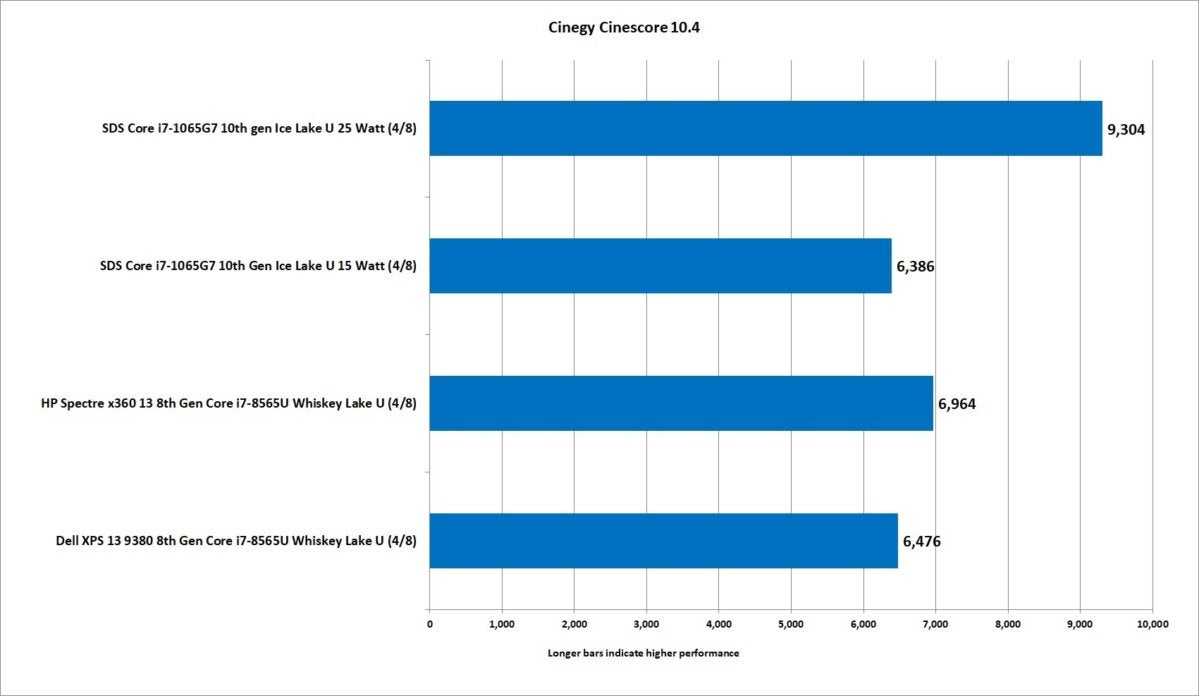
Our next encoding test is Cinegy's Cinescore benchmark. It's a stand-alone screen fashioned to measuring stick encoding performance on CPU and CUDA-supported GPUs in various popular send industry formats from SD to 8K.
The standout score is the 10th-gen Methamphetamine Lake localise to a 25W TDP. Its Cinescore performance is about 35 percent wagerer than the Dell's. The Dingle, oddly, was slightly slower than the HP. This South Korean won't be the only time either: We found the HP often outperformed the Dell XPS 13 in artwork tests, while underperforming information technology on Processor tests.
The 15-watt background for the Methamphetamine hydrochloride Lake chip was perplexing as well, as we would have expected it to outperform the Whisky Lake units. Unfortunately, we ran out of metre to rebroadcast the test.
 IDG
IDG Cinescore is designed to measure encoding peformance.
10th-gen PCMark 10 Performance
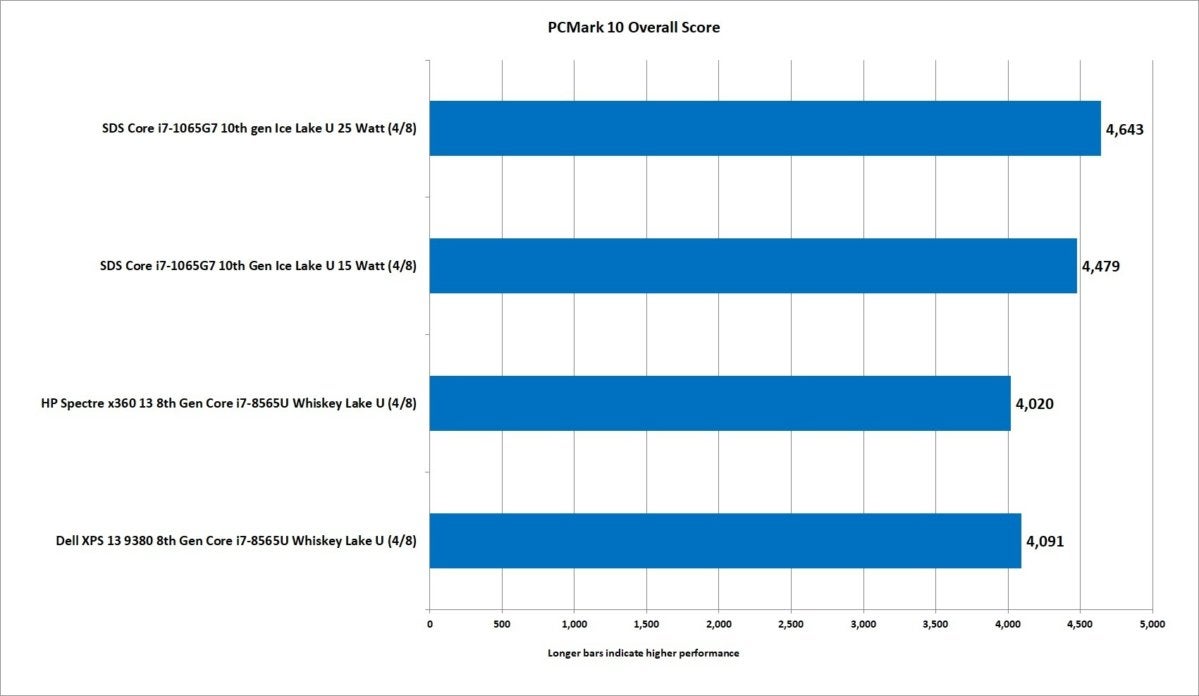
Our close test is UL's latest reading of PCMark. Among the changes PCMark 10 makes is a move back to spread-source applications such as Libre Office for office apps and GIMP, Chrome, and Firefox for application load time measurements.
The overall dirty mone goes to the 10th-gen Ice rink Lake chip, but it's not exactly a game-changer.
 IDG
IDG PCMark 10 moves to more common applications for testing
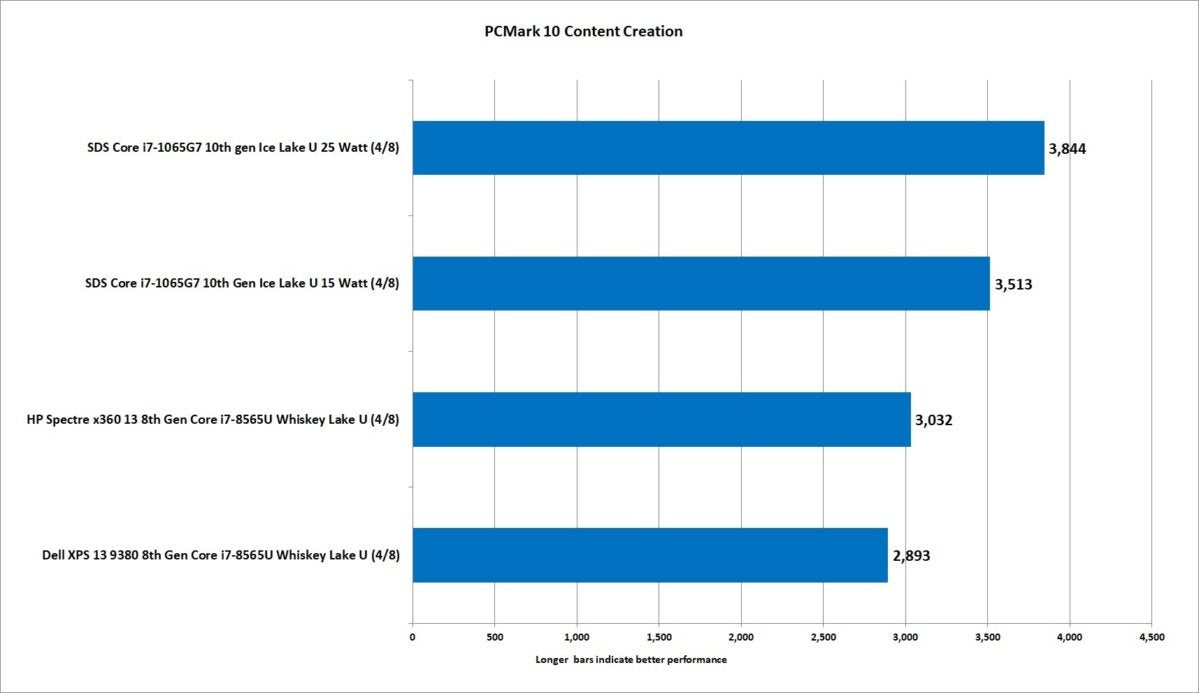
We'll break out the PCMark ensue that shows where most of Ice Lake's advantages come from: Depicted object Creation. That's where PCMark delves into "visualization," photo editing, and TV encoding. All these, if you haven't guessed, give the advantage to the Meth Lake chip.
 IDG
IDG Content creation likely gets information technology uplift from the better IGP in the Ice Lake CPU.
10th-gen Methamphetamine hydrochloride Lake Geekbench Operation
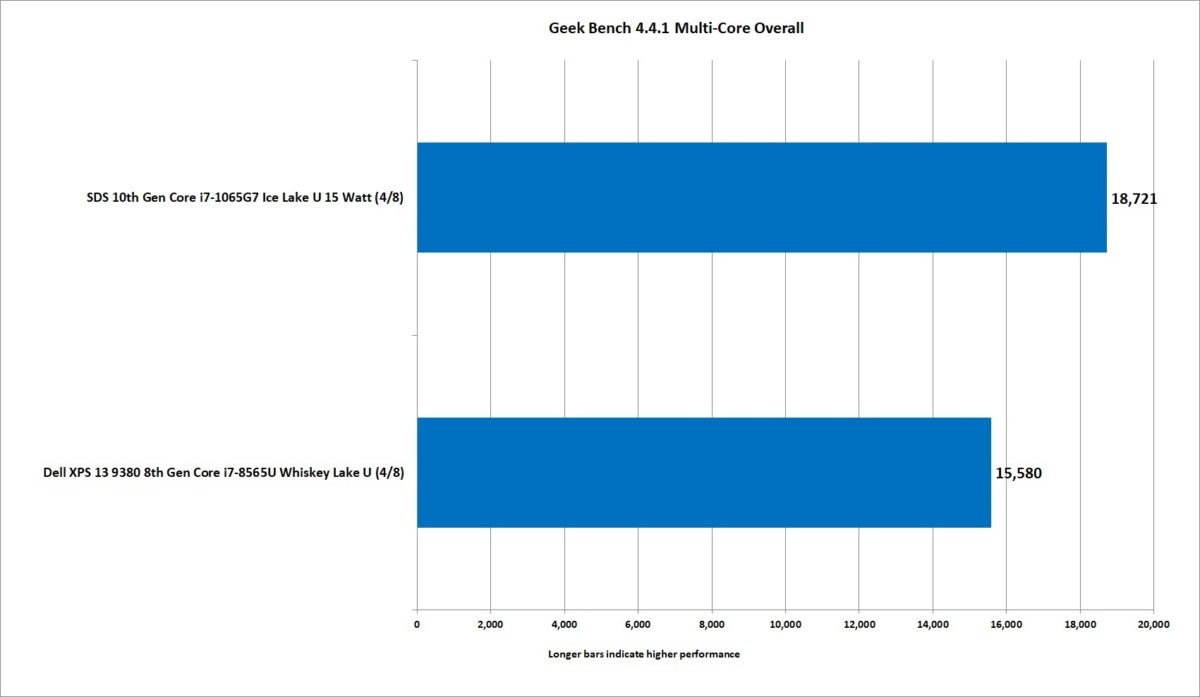
We've had our on and off moment's with Primate Lab's Geekbench but it's mostly finished how people like to lease random results generated along a opposite platform or Osmium then bash each other over the heads with them similar a Fred Flintstone animated cartoon. For this section, we overleap the 25-watt scores from the Ice Lake chip which we had incorrectly recorded or run but after comparing notes with another reviewer, we discovered there's just non remainder. Wherefore? We surmise the very short nature of the 25 different tests Geekbench runs just isn't enough of a load up to push the laptops out of their Turbo Boost windows. The results you catch are the 15-watt Ice Lake U against the Dingle XPS 13 which is among the fastest of the Whiskey Lake U laptops we've seen.
First up is Geekbench 4.4.1 multi-core public presentation where we see the Ice Lake U is 20 pct quicker. Single pith Geekbench closes the gap with the Ice Lake chip "only" about 10 percent faster than the Whisky Lake U.
 IDG
IDG What's more stimulating or so the Geekbench results are the subscores of the individual test algorithms Primate Labs uses. In many of the 25 different tests, it's mostly meh. The higher-clock speeds of the Whiskey Lake U make up IT generally a give and take in many of the tests with Whiskey Lake U also now and then winning by decent margins in SGEMM (general matrix multiplication).
But any of the tests brawl affect connected the enhanced performance of the 10th Ice Lake chip enough to greatly hike its overall nock and worthy career out.
 IDG
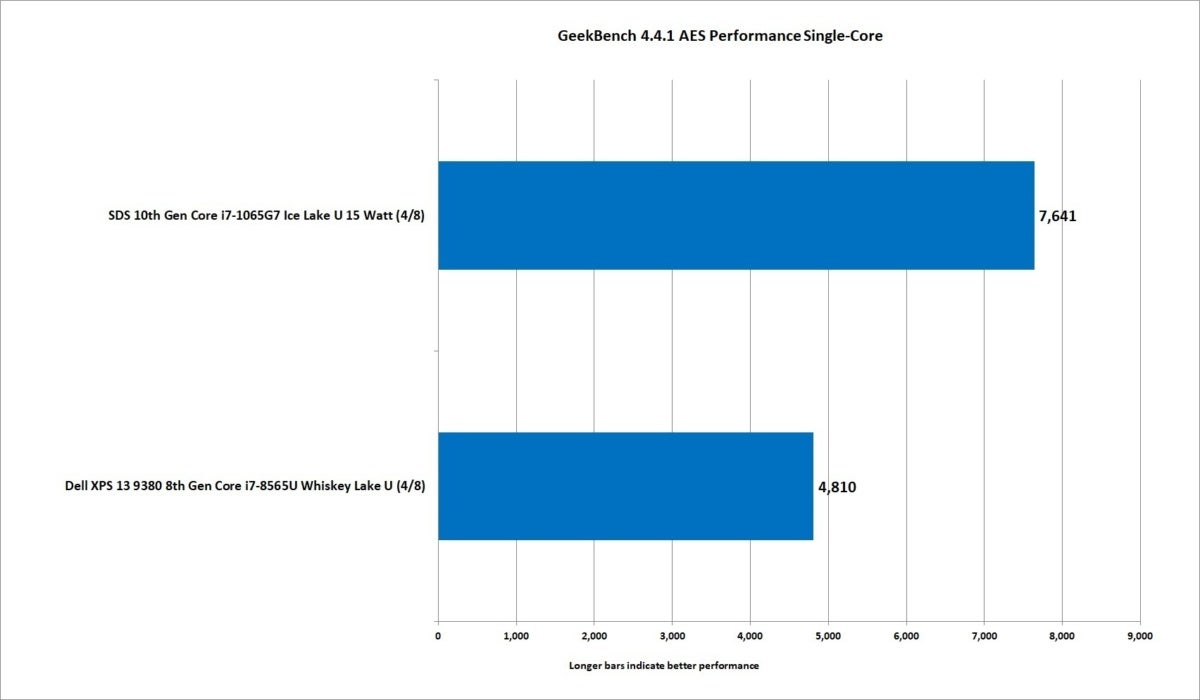
IDG The hyperbolic encoding performance of Ice-skating rink Lake rears its head in Geekbench.
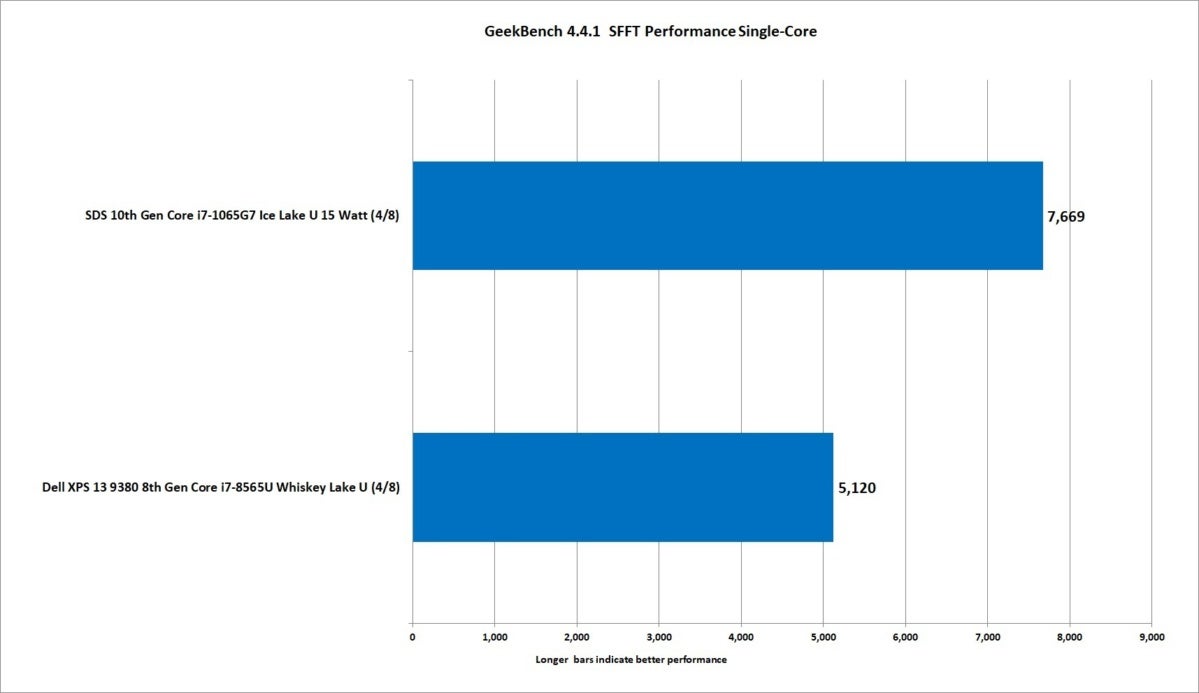
The SFFT prove, for example, performs Fast Baron Jean Baptiste Joseph Fourier Transforms and is hand-tuned for AVX512, AVX2, AVX, alone with SSE3 and SSE2 along x86. The Chalk Lake U chip is 49 percent faster than Whiskey Lake U. In the AES encryption module, Geekbench's algorithms score the Ice Lake U at 58 percent faster Whisky Lake U.
 IDG
IDG FFT performance sees a serious step up in Ice Lake too.
10th-gen Ice Lake LPDDR4X memory bandwidth
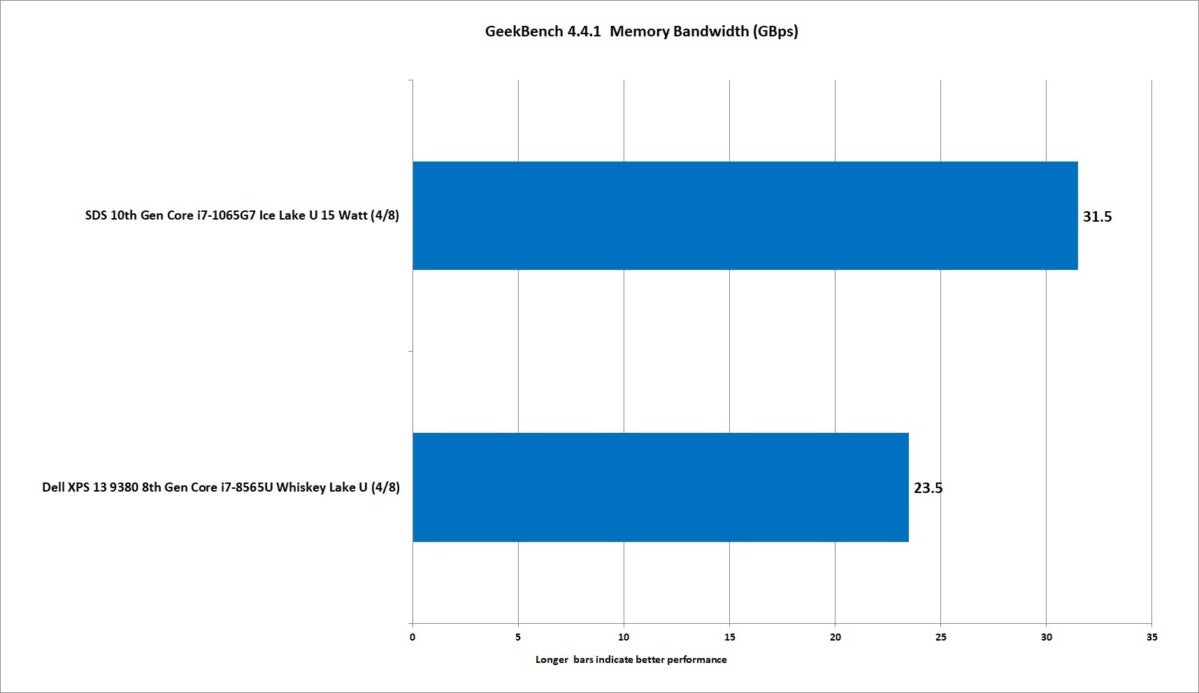
Incomparable of the key changes in Tras Lake is the adoption of LPDDR4X memory. Peerless of key changes that brings is increased memory capacity. LPDDR3 used in to the highest degree laptop tops out at 16GB patc LPDDR4X should easily shatter that denseness restrain finally. The other key reward is an increase in memory bandwidth. LPDDR3 typically tops out at 2133MHz. The LPDDR4X in Sparkler Lake laptops shoot 3,733MHz. American Samoa memory bandwidth is one of the constraints happening integrated nontextual matter performance, this is also one of the contributors to Ice Lake's better gaming performance.
 IDG
IDG LPDDR4X brings greater density and higher time speeds piece using to a lesser extent big businessman.
10th-gen Ice Lake Gaming performance
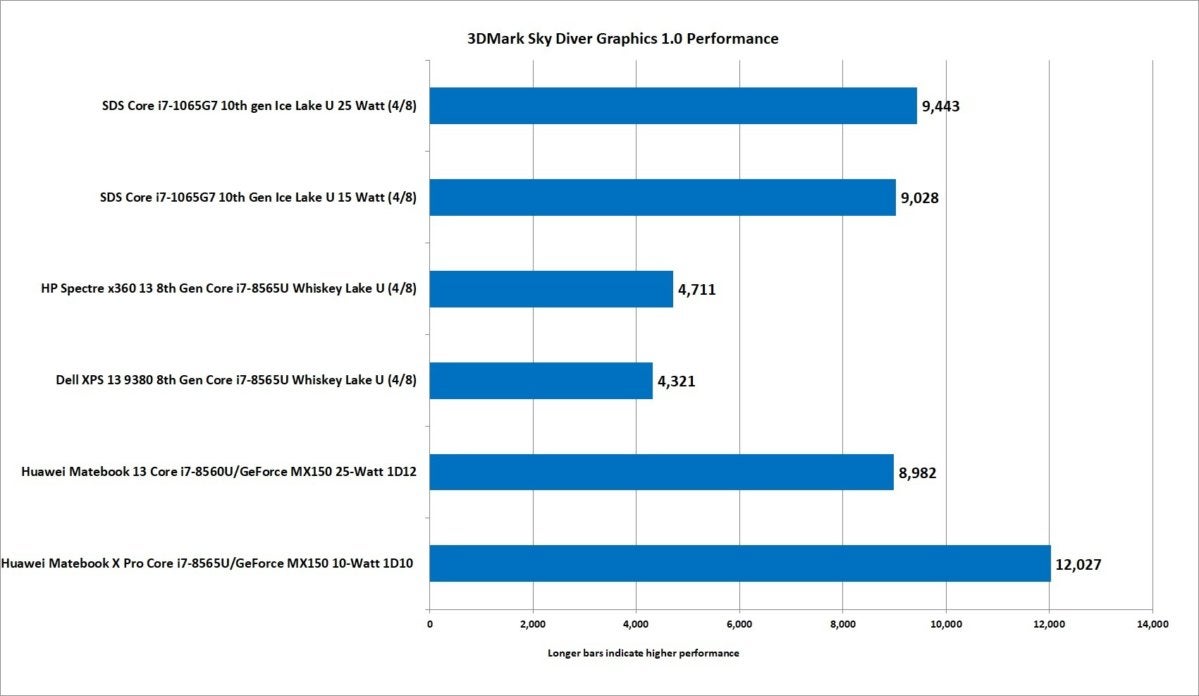
Intel has touted Gen11 graphics as a game-changer. Despite being doubting, we'd have to concord for the most part now. Premier dormy is UL's 3DMark Sky Diver. Information technology's a ignitor gaming test in the 3DMark Suite and doesn't exactly promote the GPU, but you fire see a huge performance spike for Intel's Gen 11 art over today's UHD620 art.
The 25-watt setting puts Glass Lake about 75 percent faster than the Dell's tally. Perhaps more than notable are the two laptops at the fundament of the chart. Some are Huawei Matebooks with discrete graphics. One features Nvidia's GeForce MX150 set to 10 watts (the 1D12 version), and the other features the MX150 exercise set to 25 watts (the 1D10 version).
The Flag Plus graphics with 64 EUs is utterly smooth with the 10-watt MX150 stochastic variable. Patc it still loses to the 25-Watt MX150 variant, IT's awfully close for comfort.
 IDG
IDG Whoa? An IGP coordinated a discrete graphics?!
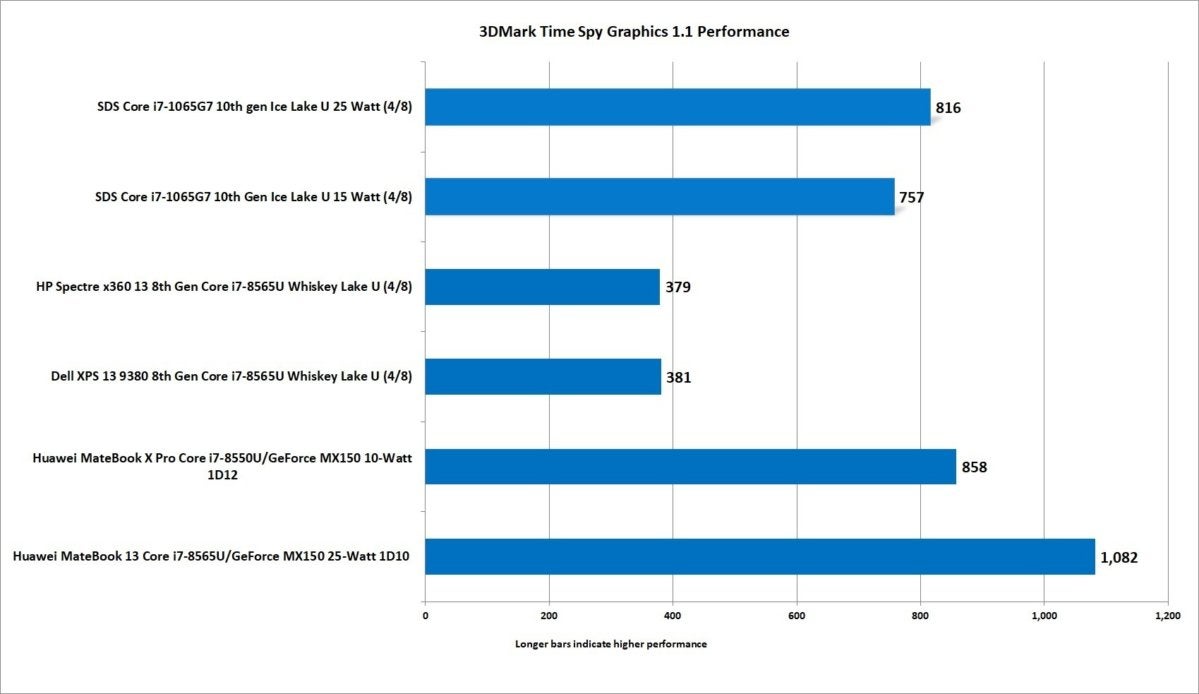
We decided to push the GPUs with a tougher test, so we likewise ran 3DMark Time Spy and looked only at the graphics performance. Largely, the results are the Sami and a bragging bring home the bacon for Intel Iris Plus artwork.
 IDG
IDG 3Dmark Time Spy is a DX12 benchmark.
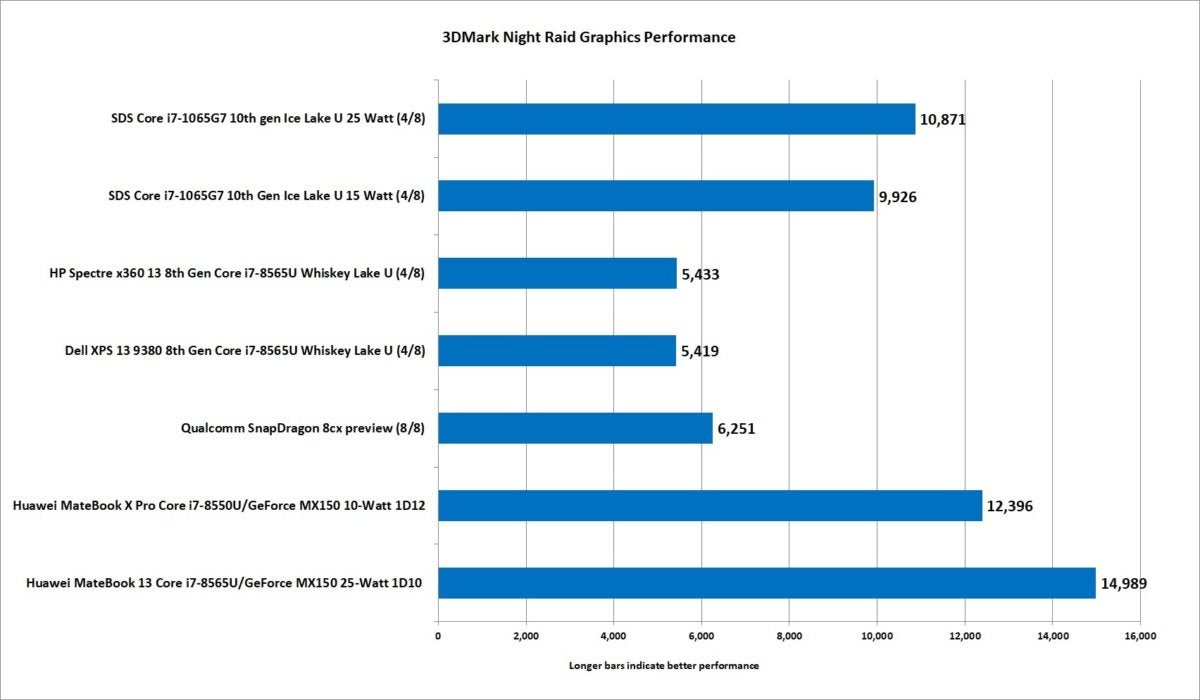
While Intel is liable hoping to rankle Nvidia's MX150-range customer base, the truth is that's fair icing on the cake. What Intel is likely more concerned with is this company named Qualcomm and its upcoming SnapDragon 8cx chip running Windows 10. At Computex, Qualcomm gave PCWorld a trailer of its graphics performance, screening it eating symmetrical spinning top Whiskey Lake U CPUs.
Now, Intel would like to see Qualcomm's 8cx and raise IT, with Ice Lake U's art performance about 45 percent higher. Yup, information technology's press-preview laptop vs. press-preview laptop time.
 IDG
IDG Intel just clapped back at Qualcomm.
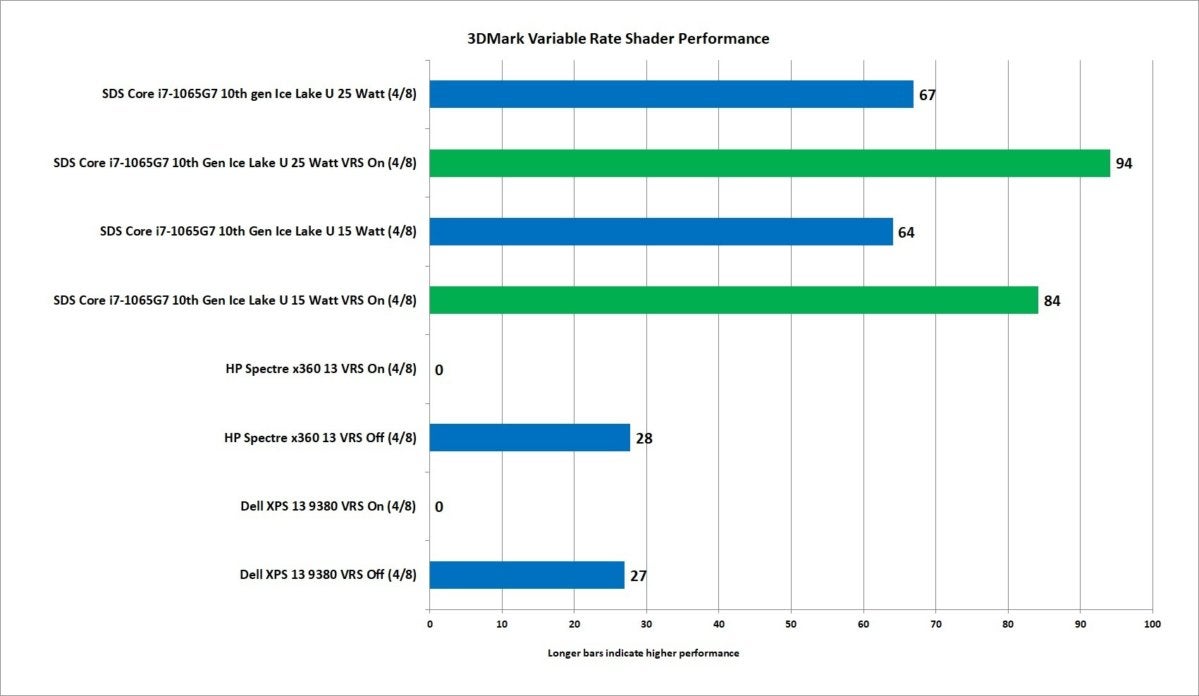
The last 3DMark result we want to register unsatisfactory is the new Variable Pace Shader performance in the artwork core. Microsoft's VRS basically enables performing high-quality shader effects on areas you care about. For areas you don't care about operating theater you won't be looking? They get lower settings.
Using a preview translation of 3DMark, we were capable to trial the feature on Ice Lake U. The results suggest that games supporting VRS could see significant increase in artwork performance on 10th-gen Ice Lake U chips.
 IDG
IDG Microsoft's VRS feature lets games get down image timber in areas that don't matter to growth shape rates.
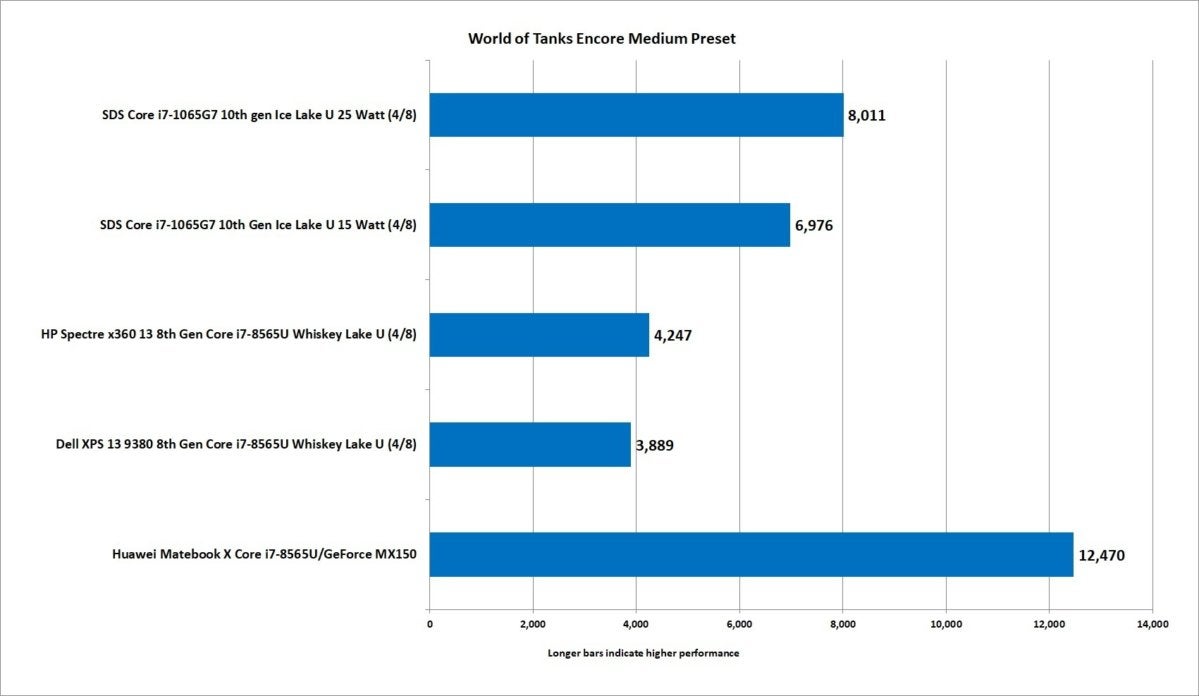
With what time we had, we ran a couple of games besides. The first one was World of Tanks Encore. It's a benchmark supported the popular free-to-looseness game, but it adds further enhancements. Largely, it validates what we saw in 3DMark.
 IDG
IDG World of Tanks Encore benchmark generally agrees with 3DMark's results.
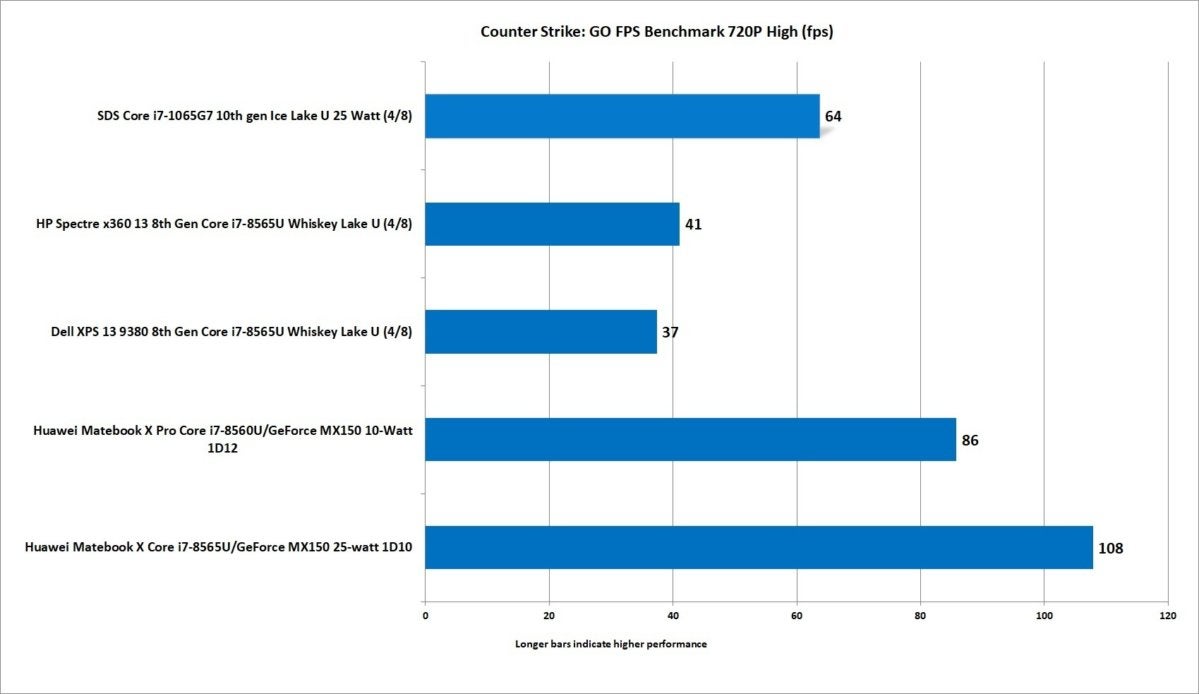
We also ran Retort Come to: Global Operations on the laptops, typeset to a more playable 720p resolution. We regrettably didn't have time to run IT in the 15-watt mode on Frost Lake, merely at 25 watts IT again torches the older UHD 620 graphics in today's laptops. The MX150 variants did get ahead far, however, so Iris Plus doesn't match discrete along all fronts.
 IDG
IDG CS:GO is actually playable generally in excess of 60 to 80 fps on Intel's Gen 11 graphics.
Conclusion
First, we'll remind everyone that this is a performance preview. We'll say that again: a Prevue. Unlike desktop CPUs, which you can largely control, laptop CPUs are about the total package. Intel's 10th-gen Ice Lake won't constitute unalterable until we view the ordinal batch of laptops and what each OEM does with it.
Therewith said, our unspecialised takeout food is that the CPU is happening a par with, operating room somewhat faster than, today's laptops in most conventional applications that don't adjoin the special sauce of landscaped encoding, AI or encoding features. In applications that touch those features, though, it's a major upgrade complete existing 14nm chips.
The veridical storm is the performance of the Gen11 graphics. Intel's integrated graphics have been the cigarette of jokes for years, but Iris Summation is a watershed. IT is a generational performance uplift over UHD graphics and might just be the surprise killer have of the CPU.

Source: https://www.pcworld.com/article/397837/intel-10th-gen-ice-lake-performance-benchmarks.html
Posted by: caseabilootich44.blogspot.com
0 Response to "Intel 10th gen Ice Lake Performance pre-review: Come for the new cores, stay for the graphics - caseabilootich44"
Post a Comment